Thursday, October 30, 2014

Vietnam: The NVA

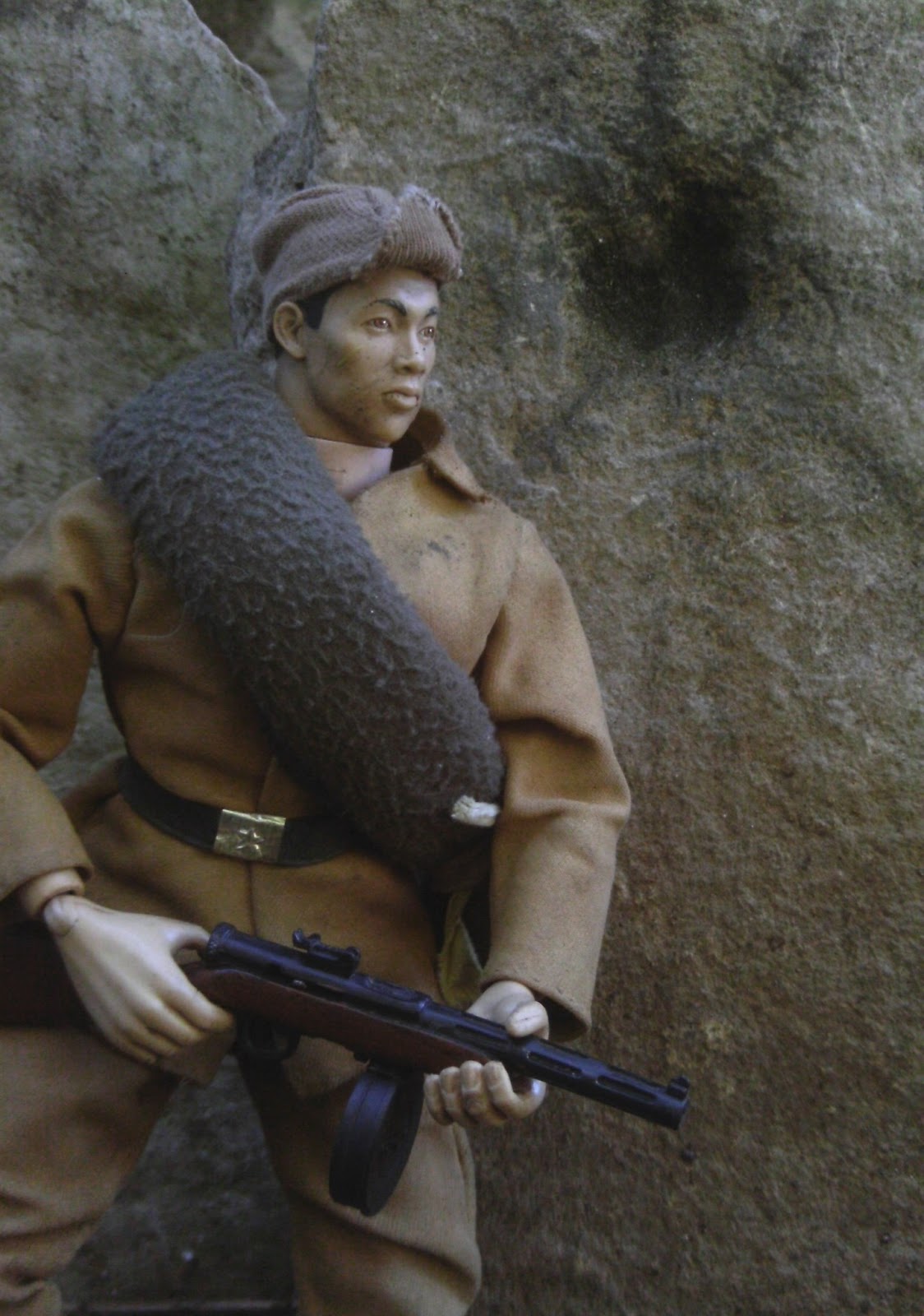
The North Vietnamese regular Army soldier (NVA)
 
During the Vietnam conflict, the American and South Vietnamese armies fought two forces. One was the infamous civilian militia, the Viet Cong, but they also had to contend with a more official force, the North Vietnamese Army. Supplied largely by the Soviet Union and People's Republic of China, the North Vietnamese Army--or NVA--first clashed with American Air Cavalry at the battle of Ia Drang Valley in 1965.
The NVA didn't wear black like their VC counterparts, but rather, military issue khaki uniforms. They wore both pith helmets and bamboo leaf cone hats, too well suited to the climate to discard.

The Vietcong and NVA could fight side-by-side, like the militia and Continental Army during the American Revolution.
 
The NVA and VC used similar weapons, but the NVA were better equipped, usually carrying Chinese-made SKS rifles and Soviet AK-47's, as seen here. 
 

Sunday, August 25, 2013

Over the Top! Trench Combat in World War One

In our last post, we took a look at scenes of trench life in the First World War. Now we'll take a glance at a trench-launched attack by Allied forces against the German trench lines. 

The Allied Plan: dislodge the Germans from their forward trench lines by attacking over the open stretch of ground known as no-mans land. Once a forest, the trees have been leveled by heavy artillery bombardments.

The German Plan: Hold back all allied attacks by raking the empty expanse of no-man's land with machine gun fire the moment the Allied soldiers come out of their trenches. 
Attacks against trenches were often met with failure. Here, French troops in 1916 are mown down by machine gun fire in an attempt to break the German lines in the battle for Verdun, France.
 
Americans also had machine guns. Here, an American in a machine gun nest keep watch for a suspected German attack in 1918.

Launching the attack! In the trench lines of Northern France, Allied soldiers go over the top in an attack against the German trenches across the field. Armed with rifles with attached bayonets, American infantrymen charge in the foreground while French soldiers attack from their lines in the background, recognizable by their bluish wool coats.

Now, as the Allied soldiers launch their attack, a German sentry spots movement from his post and quickly alerts his comrades.
 

                                                                    "Americans!"

This German is armed with a Mauser bolt-action rife. Near his hand rests a hand grenade with a wooden throwing handle, often called a "stick grenade" or "potato masher".

 
The Allies press on through a storm of shot and shell, while the Germans try to thwart their efforts.


At close range, grenades are thrown between the two contesting armies.

The allies reach the German lines and open fire before jumping in, capturing the trench!

Driving the Germans out, Allied soldiers race down the zig-zagging earth channels to flush out the enemy.

Clearing the trench of the Germans, the Allies have gained a toehold in the German trench system. Even if they only captured twenty-five yards worth of German trench line and hold it, it is considered a tentative victory.
We hope you enjoyed this post!

Wednesday, August 14, 2013

The Trenches of World War I

In this post, we'll take a look into scenes of trench warfare in World War I.
 
In 1914, every superpower in Europe went to war after a dispute between Austria and Serbia escalated into a multi-national conflict. The first World War, or "the Great War" as it was known then, would last until 1918. Up until 1914, the great armies of Europe fought battles over open ground, but the invention of rapid-fire rifles and machine guns forced the soldiers of the allied and central powers to dig into the contested European countryside for protection.

A French soldier walks through a trench line in 1914, shortly after the wars outbreak. The French army did not wear camouflage, but instead gray or blue overcoats over sky blue or red pants.
 
Here, a French Algerian colonial soldier keeps watch over the stretch of no-man's land between the lines.
 

He is armed with a French machine-gun that would be used throughout the war, though it was known for malfunctioning.

Four years after the wars start, the Americans entered the conflict on the Allied power's side against Germany, Turkey, Austria and Bulgaria. The Trenches were still the main tactic in combat.
Machine gunners guard the approaches facing the enemy trenches.

Daily life in the rain-soaked trenches was very hard. Rats, lice and disease infested the soldier's living conditions,

While constant enemy shelling rained down on the soldiers relentlessly, wrecking havoc on the soldier's nerves, morale and earthen dugouts.


While trenches were dirty, hazardous and at times death traps, they none the less provided basic protection from the storm of lead and steel the enemy rained down on them. But both sides knew they could not stay in their trenches forever; sooner or later, they would have to attack the enemy lines to dislodge them if they want to make any headway in the war. Leaving the relative protection of a trench line and attacking the enemy lines head-on was called "going over the top".
In their trench in Northwest France, German troops prepare for a suspected attack against their lines from the Allied forces of Great Britain, France or their powerful ally, the United States.
More updates to come soon!

Sunday, February 17, 2013

The War in Korea


A North Korean soldier
in the Korean War, 1950-1953
After the defeat of the Japanese in the Second World War, the Korean Peninsula was occupied by the American and Russian armies. The Koreans wanted to have their country reconstructed as one unified Korean nation after thirty five years of Japanese occupation; but they could not decide if Korea should be a democracy, like the United States, or if they should unanimously accept the Communist model of Government introduced by the Soviet Union. The American and Soviet Governments decided to divide Korea along the 38th parallel, allowing the two halves of Korea to be governed by separate methods.
 
The Koreans, however, were dissatisfied with this arrangement. In 1950, five years after the end of World War II, the Soviet-backed North Korean army crossed the 38th Parallel in a campaign to take over South Korea in an attempt to unify the country under Communism.
Three days after the fighting began, the North Korean army took the South Korean capitol city of Seoul.


At the start of the war, both of the Korean armies
armed themselves with a mix of American,
Japanese and Soviet uniforms and gear.
 

It wasn't long until the Americans became involved.  The United Nations, a newly-formed body of Nations from around the world assembled in the aftermath of the Second World War to assist in international policy decision making, approved American involvement in stemming the tide in South Korea. Though many Nations dedicated against communism would send arms, men and relief aid into the conflict, the United States would take the leading role--and therefore it was decided that Douglas MacArthur, the American General who liberated the Philippines in World War II, would be the Commanding General in charge of all Democratic forces in Korea.
"Communism was acting in Korea just as Hitler, Mussolini and the Japanese had acted. I felt certain that if South Korea was allowed to go unchallenged it would mean a third world war." ~Harry S. Truman, President of the United States during the Korean Conflict
An American Marine in the fight to hold the Pusan Perimeter in the first year of the Korean Conflict.

The first United States troops to see action was a rifle company in near Osan, thirty miles South of Seoul. The North Koreans pushed South until the Americans only held the peninsula by a toehold on the Southeastern corner, where the American Army based in Pusan tried to hold onto their last defensive line, the "Pusan Perimeter".

An American Soldier early in the Korean War
 On September 15th, 1950, General Douglas MacArthur made a bold diversionary action and made an amphibious landing in Incheon, just a few miles Southwest of Seoul.

Now with the Americans in front and behind, and their supply lines cut, the North Koreans were compelled to withdraw from the Pusan Perimeter. Seoul was liberated on September 26th, and UN forces spearheaded by the Americans led a subsequent drive North, capturing the Communist capitol of Pyongyang on November 25th. The war wasn't over yet, however, as Chinese intervention on the North Korean's behalf coupled with harsh winter weather drove the UN armies back over the 38th Parallel.


The Americans were ill prepared for the harsh Korean winters, and countless
cases of frostbite and trenchfoot claimed many limbs.
 

A Chinese soldier in a white quilted winter uniform.


An American look-out post on the front lines


 The American and UN forces began a General retreat across the frozen mountainous hills of Korea, the endurance of the Americans in the harsh elements becoming a legend of perseverance. A fierce rear guard action was kept up, with whole divisions of Chinese attackers being almost wiped out by UN aircraft.

American troops huddled around a camp fire
during the retreat South.


Unfortunately, small comforts such as camp fires could draw Chinese artillery fire,
which was noted for its ferocity.


American Artillery pounds away on Chinese positions in Korea.

The Americans regrouped in Southern Korea and fought off their attackers, but fighting would continue for three more years until an armistice (temporary peace agreement) was agreed upon in 1953.
Sixty years later, the issue of a unified Korea is unresolved.

Tuesday, November 27, 2012

"Go For Broke!"

 The Nisei Battalions of WWII

 The Japanese Attack on Pearl Harbor that launched the United States into the Second World War posed an interesting situation for Japanese-American citizens living in the United States. Many Americans believed that Americans of Japanese decent would assist the Japanese empire in its war against the United States by working as spies and committing acts of sabatauge. As a result of these fears, the U.S. Government decided to round up all Japanese-decent Americans living on America's Western coast and deport them to hastily built internment camps deep within the country. 

The Japanese American internment camps were
hastily constructed and located deep in the
U.S. interior, in nearly uninhabitable deserts.
"I am for immediate removal of every Japanese on the West Coast to a point deep in the interior. I don't mean a nice part of the interior either. Herd 'em up, pack 'em off and give 'em the the inside room in the badlands." ~ Hearst newspaper chain columnist

Despite the discrimination that befell the Japanese Americans, by 1942 the need for soldiers began to rise. New laws were passed, allowing minorities such as African Americans and Japanese Americans to enter the U.S. armed forces. However, prejudice still had a part to play; Asian and African Americans were placed in segregated all-black or all-Asian units. Further still, these segregated units were commanded by white officers.

In 1943, the 442nd battalion of second-generation (or "Nisei") Japanese American infantrymen landed with the Allies in German-held Italy.
In the first few weeks of fighting, the Japanese American soldiers proved themselves to be fiercely loyal to the United States. Many of the Battalion's white officers were highly skeptical about the performance of the Nisei troops; they thought that they were incapable of preforming as effective soldiers, and would fail in combat. But when the fierce fighting began in the forests and mountains of Italy, the Nisei soldiers proved themselves to be excellent fighting men with exceptional coolness and bravery under fire.
"Send me more of these men!" ~General Mark Clark, commander of the 442nd Nisei Battalion, commenting on the effectiveness of the Japanese American troops after their first large-scale engagement with the Germans


One Nisei soldier takes a drink from a canteen while
his comrade keeps watch  


A Nisei soldier in a field hospital. The only complaint the Army had of the
Japanese-American troops were multiple reports of soldiers who, once they had
recovered just well enough to carry a gun, would sneak out of the field hospitals without
an official release and join their comrades in the front where the fighting was.
The 442nd Infantry Batallion had to pay a high price for their bravery. their losses were so high, what remained of the unit was merged with the newly-formed 100th Nisei Batallion. Together they formed the 442/100th Nisei Batallion.

The Nisei often found themselves up against
a tough and determined enemy. Here a German paratrooper,
 fighting on the ground, defends a line
in Western Europe, 1944.  
In the months that followed, the 442/100th Nisei Batallion fought courageously in Italy until they were chosen to be transferred to Southern France, where their exceptional fighting skills were needed most. Their mission was to rescue a detachment of Americans, the 36th Texas Infantry Batallion, which had been surrounded in the woods by overwhelming numbers of German tanks and infantrymen. The 442/100th Nisei Batallion was selected to break through the German choke hold and rescue the trapped Texans. They fought in the forests, battling combat-hardened Germans and the new King Tiger I tanks that proved to be one of the most formidable of German armored vehicles. The Nisei lost many men in the fighting, but eventually they broke
 through the German lines and reached the trapped Texans, urged on by their famous battle-cry "go for broke!" a motto that had orgins in a traditional Japanese gambling game.  
 
"[The Germans] would hit us from one flank, and then the other, then from the front and rear...we were never so glad to see anyone as those fighting Japanese Americans."~36th Texas Infantryman recalls the rescue of his unit by the 442/100th Nisei Battalion

A German soldier in Italy.
Back in Italy once again, the Nisei battalion found themselves up against German resistance in the villages of Northern Italy.
A 442/100th Nisei soldier works
his way through one of the shattered Italian villages that
were caught in the fight to liberate
 the Italian peninsula from the Nazis.


A Nazi paratroop officer draws his pistol as a nisei patrol nears the German-held village. 


Soldiers fighting in Urban areas often relied on hand grenades to improve their firepower capabilities.


Boom! A German soldier is hit by a grenade in
the bitter fighting in Italy

The fighting in Italy would last for only a few more months before all the German resistance would be mopped up. When the allies reached the German capitol of Berlin in April, 1945, the Nazi regime had collapsed and with it, German resistance in Italy ground to a halt with the end of the war in Europe. 


By the wars end, the 442/100th Nisei Battalion had earned 18,143 medals.
1 Congressional Medal of Honor,
47 Distinguished Service Crosses,
350 Silver Stars,
810 Bronze Stars,
and more than 3,600 Purple Hearts.

During the Presidency of Ronald Reagen (1981-1989), twenty-eight additional Nisei veterans who fought in the Second World War were awarded the Congressional Medal of Honor, America's highest military award for conspicuous bravery.