Showing posts with label Battle. Show all posts

Sunday, August 25, 2013

Over the Top! Trench Combat in World War One

In our last post, we took a look at scenes of trench life in the First World War. Now we'll take a glance at a trench-launched attack by Allied forces against the German trench lines. 

The Allied Plan: dislodge the Germans from their forward trench lines by attacking over the open stretch of ground known as no-mans land. Once a forest, the trees have been leveled by heavy artillery bombardments.

The German Plan: Hold back all allied attacks by raking the empty expanse of no-man's land with machine gun fire the moment the Allied soldiers come out of their trenches. 
Attacks against trenches were often met with failure. Here, French troops in 1916 are mown down by machine gun fire in an attempt to break the German lines in the battle for Verdun, France.
 
Americans also had machine guns. Here, an American in a machine gun nest keep watch for a suspected German attack in 1918.

Launching the attack! In the trench lines of Northern France, Allied soldiers go over the top in an attack against the German trenches across the field. Armed with rifles with attached bayonets, American infantrymen charge in the foreground while French soldiers attack from their lines in the background, recognizable by their bluish wool coats.

Now, as the Allied soldiers launch their attack, a German sentry spots movement from his post and quickly alerts his comrades.
 

                                                                    "Americans!"

This German is armed with a Mauser bolt-action rife. Near his hand rests a hand grenade with a wooden throwing handle, often called a "stick grenade" or "potato masher".

 
The Allies press on through a storm of shot and shell, while the Germans try to thwart their efforts.


At close range, grenades are thrown between the two contesting armies.

The allies reach the German lines and open fire before jumping in, capturing the trench!

Driving the Germans out, Allied soldiers race down the zig-zagging earth channels to flush out the enemy.

Clearing the trench of the Germans, the Allies have gained a toehold in the German trench system. Even if they only captured twenty-five yards worth of German trench line and hold it, it is considered a tentative victory.
We hope you enjoyed this post!

Sunday, February 17, 2013

The War in Korea


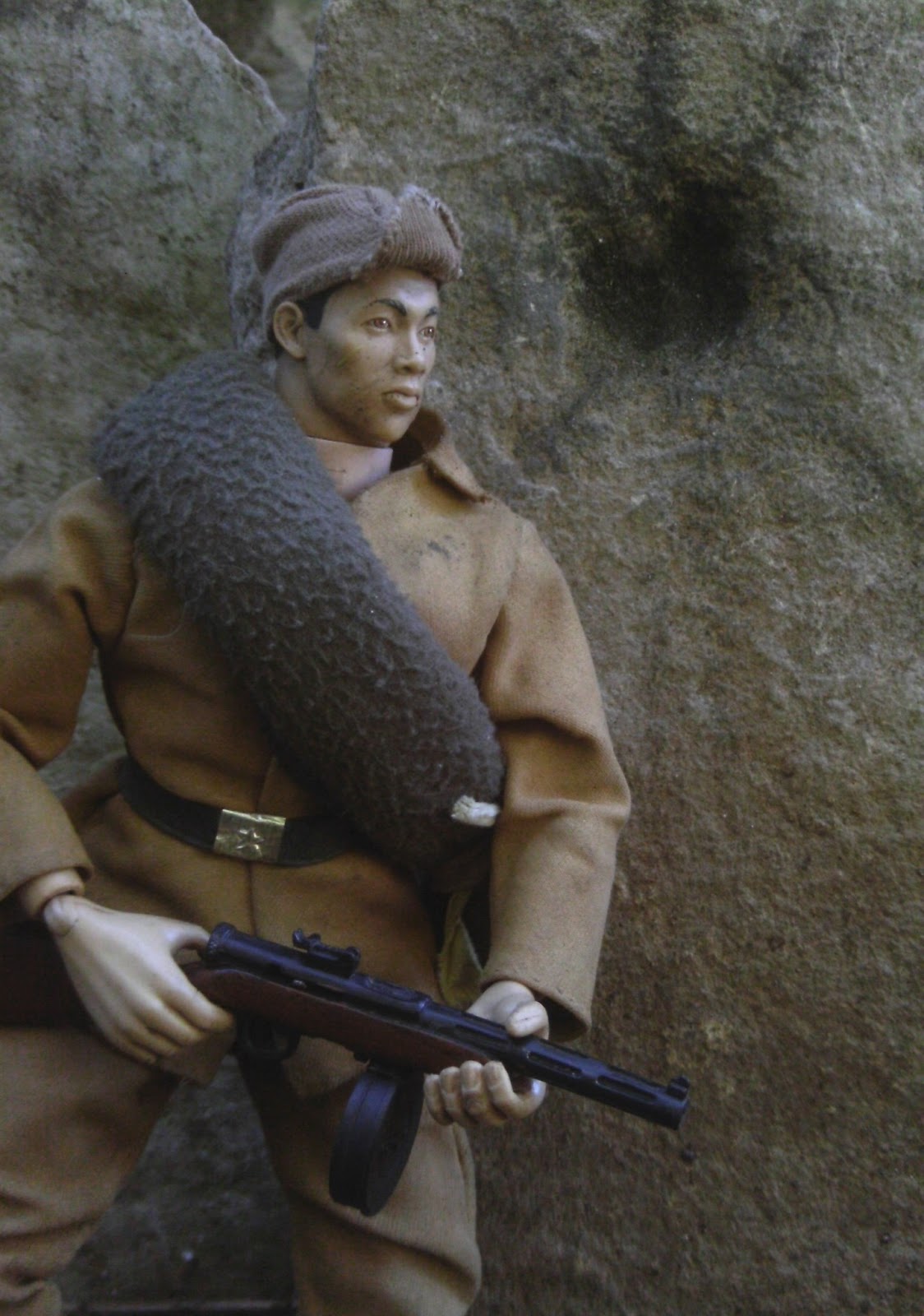
A North Korean soldier
in the Korean War, 1950-1953
After the defeat of the Japanese in the Second World War, the Korean Peninsula was occupied by the American and Russian armies. The Koreans wanted to have their country reconstructed as one unified Korean nation after thirty five years of Japanese occupation; but they could not decide if Korea should be a democracy, like the United States, or if they should unanimously accept the Communist model of Government introduced by the Soviet Union. The American and Soviet Governments decided to divide Korea along the 38th parallel, allowing the two halves of Korea to be governed by separate methods.
 
The Koreans, however, were dissatisfied with this arrangement. In 1950, five years after the end of World War II, the Soviet-backed North Korean army crossed the 38th Parallel in a campaign to take over South Korea in an attempt to unify the country under Communism.
Three days after the fighting began, the North Korean army took the South Korean capitol city of Seoul.


At the start of the war, both of the Korean armies
armed themselves with a mix of American,
Japanese and Soviet uniforms and gear.
 

It wasn't long until the Americans became involved.  The United Nations, a newly-formed body of Nations from around the world assembled in the aftermath of the Second World War to assist in international policy decision making, approved American involvement in stemming the tide in South Korea. Though many Nations dedicated against communism would send arms, men and relief aid into the conflict, the United States would take the leading role--and therefore it was decided that Douglas MacArthur, the American General who liberated the Philippines in World War II, would be the Commanding General in charge of all Democratic forces in Korea.
"Communism was acting in Korea just as Hitler, Mussolini and the Japanese had acted. I felt certain that if South Korea was allowed to go unchallenged it would mean a third world war." ~Harry S. Truman, President of the United States during the Korean Conflict
An American Marine in the fight to hold the Pusan Perimeter in the first year of the Korean Conflict.

The first United States troops to see action was a rifle company in near Osan, thirty miles South of Seoul. The North Koreans pushed South until the Americans only held the peninsula by a toehold on the Southeastern corner, where the American Army based in Pusan tried to hold onto their last defensive line, the "Pusan Perimeter".

An American Soldier early in the Korean War
 On September 15th, 1950, General Douglas MacArthur made a bold diversionary action and made an amphibious landing in Incheon, just a few miles Southwest of Seoul.

Now with the Americans in front and behind, and their supply lines cut, the North Koreans were compelled to withdraw from the Pusan Perimeter. Seoul was liberated on September 26th, and UN forces spearheaded by the Americans led a subsequent drive North, capturing the Communist capitol of Pyongyang on November 25th. The war wasn't over yet, however, as Chinese intervention on the North Korean's behalf coupled with harsh winter weather drove the UN armies back over the 38th Parallel.


The Americans were ill prepared for the harsh Korean winters, and countless
cases of frostbite and trenchfoot claimed many limbs.
 

A Chinese soldier in a white quilted winter uniform.


An American look-out post on the front lines


 The American and UN forces began a General retreat across the frozen mountainous hills of Korea, the endurance of the Americans in the harsh elements becoming a legend of perseverance. A fierce rear guard action was kept up, with whole divisions of Chinese attackers being almost wiped out by UN aircraft.

American troops huddled around a camp fire
during the retreat South.


Unfortunately, small comforts such as camp fires could draw Chinese artillery fire,
which was noted for its ferocity.


American Artillery pounds away on Chinese positions in Korea.

The Americans regrouped in Southern Korea and fought off their attackers, but fighting would continue for three more years until an armistice (temporary peace agreement) was agreed upon in 1953.
Sixty years later, the issue of a unified Korea is unresolved.

Friday, July 27, 2012

After D-Day:

The Battle of the Hedgerows

After the successful Allied invasion of the German-held French coast of Normandy, the armies of the Allied forces in Europe began moving inland toward Germany. 
Although the German army lost their holdings on the coast, they put up a fight further inland. But rather than fight one pitched battle, the Allied armies fought a series of sporadic engagements in rural France in a campaign that became simply known as the battle of the Hedgerows. The name for the culminated effort was derived from the extensive cultivated hedge systems that laced the French countryside. 
A U.S. Paratrooper observes the surrounding French countryside after a summer rain.
   It was a common practice for soldiers to dig "fox holes" for protection against enemy fire when their unit temporarily halted their advance.
A U.S. Soldier digs his fox hole using a folding shovel. A hastily dug fox hole could average about four feet deep, and could accommodate one person; with a little more time, a soldier usually dug a two-man position.  


A newly dug fox hole!

The Allies were not the only ones to dig in. Here are two German soldiers (also paratroopers) in their fox hole. Note their "stick" hand grenades readily accessible laid out in front of them.

 To take a village
Scores of French towns and villages found themselves caught up in the fighting as American, British and Canadian forces clashed with the German armies for possession of Western Europe. 
 
Two American officers discuss operations in a tent serving as a temporarily headquarters.
The German Panther tank, an effective weapon designed to fight Soviet T-34's.
"The town is well defended by a battalion of German tanks, as well as infantry." 
 
Attack! Allied troops attack the village from the South side.
The Allies press steadily onward, taking over the German positions.

Take Cover! A U.S. Infantryman just escapes from the blast of a German tank shell.


Direct Hit! The German tank is in turn hit by an anti-tank rocket launcher, known commonly as the "Bazooka". The slang term comes from a musical instrument by the same name that many believed had a strong resemblance in appearance to the weapon.
 The battle of the Hedgerows, an Allied victory, lasted from late June 1944 to December 1944.

Tuesday, March 13, 2012

Field Atillery:

The U.S. 155mm howitzer

A U.S. howitzer in action

Two soldiers carry a crate of
artillery ammunition

In the second World War, artillery was beginning to get more advanced. The day of the classic cannon-on-wagon-wheels was over; and the age of modern artillery had begun. 

A U.S. howitzer in the Pacific Theatre,
Second World War

 One common piece of artillery in WWII was the 155 millimeter howitzer. A howitzer is a multi-purpose gun; it can fire direct, shooting strait ahead at a visible target, or it can fire indirect, firing upwards into the air so the shell can come down on top of a target. 
Allied artillery giving indirect fire
in France, 1944
Direct fire was commonly used against walls or in defense; indirect fire could attack enemy-held hilltop positions. That made it a very popular weapon.

Two U.S. Artillerymen load and prepare to
fire their 155 mm howitzer

 Artillery pieces were often named according to what size of ammunition it used. The shell (bomb) fired by this particular gun had a diameter of 155mm. Hence it's name, the 155mm howitzer.
Securing the fold-out legs of a 155mm howitzer in
preparation to fire

Bombs away! A 155mm howitzer in the
Korean War

Artillery position, South Pacific Theatre, WWII

Thursday, July 28, 2011

The Invasion of Crete

On May 20th, 1941, Nazi German paratroopers (or "Fallschirmjager") attacked and took the British held island of Crete in the Mediterranean sea by airborne assault. The Nazi paratroopers, landing on an enemy held island and capturing it by suprise (despite being outnumbered by the British and Greek defenders), proved to the world that airborne assaults were indeed successful against a numerically superior foe.

Two German paratroopers recover a crate full of ammunition and guns that was dropped by parachute on Crete.


After recovering the weapons, the Nazis head torwards the allied airfields to secure them. This denied the British the ability to send in re-enforcements by plane.


A German Officer.


The soldier in the foreground is wearing a unique style of German helmet, specially designed for paratroopers: it does not have the signature ear protection on the side that German helmets are known for. The blue-ish colored cloth belt he wears on his front is a ammunition bandolier.


The battle of Crete was a German victory; but a costly one. The surviving British and Greek troops were evacuated by ship, and as for the Germans, their losses were so costly that for the rest of the war they would be fighting as ground troops, like regular infantry, rather than jumping out of airplanes behind enemy lines.