Showing posts with label World War One. Show all posts

Sunday, August 25, 2013

Over the Top! Trench Combat in World War One

In our last post, we took a look at scenes of trench life in the First World War. Now we'll take a glance at a trench-launched attack by Allied forces against the German trench lines. 

The Allied Plan: dislodge the Germans from their forward trench lines by attacking over the open stretch of ground known as no-mans land. Once a forest, the trees have been leveled by heavy artillery bombardments.

The German Plan: Hold back all allied attacks by raking the empty expanse of no-man's land with machine gun fire the moment the Allied soldiers come out of their trenches. 
Attacks against trenches were often met with failure. Here, French troops in 1916 are mown down by machine gun fire in an attempt to break the German lines in the battle for Verdun, France.
 
Americans also had machine guns. Here, an American in a machine gun nest keep watch for a suspected German attack in 1918.

Launching the attack! In the trench lines of Northern France, Allied soldiers go over the top in an attack against the German trenches across the field. Armed with rifles with attached bayonets, American infantrymen charge in the foreground while French soldiers attack from their lines in the background, recognizable by their bluish wool coats.

Now, as the Allied soldiers launch their attack, a German sentry spots movement from his post and quickly alerts his comrades.
 

                                                                    "Americans!"

This German is armed with a Mauser bolt-action rife. Near his hand rests a hand grenade with a wooden throwing handle, often called a "stick grenade" or "potato masher".

 
The Allies press on through a storm of shot and shell, while the Germans try to thwart their efforts.


At close range, grenades are thrown between the two contesting armies.

The allies reach the German lines and open fire before jumping in, capturing the trench!

Driving the Germans out, Allied soldiers race down the zig-zagging earth channels to flush out the enemy.

Clearing the trench of the Germans, the Allies have gained a toehold in the German trench system. Even if they only captured twenty-five yards worth of German trench line and hold it, it is considered a tentative victory.
We hope you enjoyed this post!

Wednesday, August 14, 2013

The Trenches of World War I

In this post, we'll take a look into scenes of trench warfare in World War I.
 
In 1914, every superpower in Europe went to war after a dispute between Austria and Serbia escalated into a multi-national conflict. The first World War, or "the Great War" as it was known then, would last until 1918. Up until 1914, the great armies of Europe fought battles over open ground, but the invention of rapid-fire rifles and machine guns forced the soldiers of the allied and central powers to dig into the contested European countryside for protection.

A French soldier walks through a trench line in 1914, shortly after the wars outbreak. The French army did not wear camouflage, but instead gray or blue overcoats over sky blue or red pants.
 
Here, a French Algerian colonial soldier keeps watch over the stretch of no-man's land between the lines.
 

He is armed with a French machine-gun that would be used throughout the war, though it was known for malfunctioning.

Four years after the wars start, the Americans entered the conflict on the Allied power's side against Germany, Turkey, Austria and Bulgaria. The Trenches were still the main tactic in combat.
Machine gunners guard the approaches facing the enemy trenches.

Daily life in the rain-soaked trenches was very hard. Rats, lice and disease infested the soldier's living conditions,

While constant enemy shelling rained down on the soldiers relentlessly, wrecking havoc on the soldier's nerves, morale and earthen dugouts.


While trenches were dirty, hazardous and at times death traps, they none the less provided basic protection from the storm of lead and steel the enemy rained down on them. But both sides knew they could not stay in their trenches forever; sooner or later, they would have to attack the enemy lines to dislodge them if they want to make any headway in the war. Leaving the relative protection of a trench line and attacking the enemy lines head-on was called "going over the top".
In their trench in Northwest France, German troops prepare for a suspected attack against their lines from the Allied forces of Great Britain, France or their powerful ally, the United States.
More updates to come soon!

Friday, March 6, 2009

World War I, Life in the Trenches: Part Two

In part one of the entry series, we saw how trench warfare became the main method of fighting on the western front during the First World War. Now, we will not only see what took place, but what day-to-day life was like for the soldiers in the trenches.


On Guard Duty. Both sides had to be careful to watch the enemy lines at all times, so that if an attack came they would not be caught off guard. When a soldier was on guard duty, he had to keep out of sight, for enemy snipers were always a danger.


Home Sweet Home. Soldiers tried to find what little shelter from the elements that they could, but the constant shelling and bombing meant that the shelter had to be "bomb-proof". The most common type of shelter was, therefore, a small cave-like hole dug out of the forward side of the trench. These were often nick-named "worm holes".


Some underground shelters had log-lined walls to hold the dirt back.


What's For Lunch? All meals were usually pre-packaged, or was prepared in the rear lines and brought it to the front lines in buckets. Cooking in the front lines was prohibited, as smoke from cook fires could attract grenades and mortar fire. The most common meal for the Allied soldiers was mass-produced canned corn beef and potatoes. This was often accompanied by tea if you were in the British Army.

All soldiers were equipped with a mess kit consisting of a multi-purpose tin pan with a removable lid, and a knife, fork, and spoon, usually wrapped in a napkin.


Winter In The Trenches. While spring and fall brought mostly rain to the trench-laced French farmland, winter often brought bouts of cold, uncomfortable rain or snow showers.


A soldier keeps watch over the trench lines after a light snowfall.Winter was the worst season of all for soldiers in the trenches. The winter also brought many new problems; frostbite and trenchfoot, a condition received from standing in cold water for extended periods, proved devastating. Disease was common year-round, but in the winter it increased drastically, claiming the lives of thousands of soldiers on both sides.

A soldier makes his way through a trench knee-deep in mud.


As we bring this dual-part entry to a close, we hope that you all have enjoyed this entry series! Thank you all for the comments as we return to the blog-world, and we shall be updating soon.

Friday, April 18, 2008

World War I: Life in the Trenches, part 1.

In this next series of entries, we'll be focusing on life in the trenches during the first world war.

The Germans had dug the first trenches of the war during a retreat in the battle of the Marne, in 1914. To hold back the pursuing British forces, they started to dig in. This new defense stopped the British in their tracks. Then followed what historians call "The Race to the Sea" in which both sides started to march north and try to outflank the enemy, digging more trenches as they went. By the winter of 1914, the Western front had turned into a "ribbon of death", or line of trenches that stretched 475 miles from the Belgian coast to Switzerland, with a small strip of no-man's-land in between the two opposing sides.


Digging the new trench.


Displaced dirt was thrown over the top of trench and was piled on the side facing the enemy lines.

The trench is half-done! The man in the rear is placing logs in place to hold back the displaced dirt.

Every once and a while, the soldiers had to stop constructing the trench in order to fight; then resume the digging.

This soldier is preparing to throw a grenade, a small lightweight bomb that could easily be thrown by hand into an enemy position. Grenade duels were common, for it enabled the soldiers to fight without being exposed to enemy rifle or machine-gun fire. Finished! The completed trench is done, and supports of logs and corrugated iron have been put in to strengthen the walls and keep them from collapsing inward.

We hope you enjoyed this entry! We will be updating soon.

Monday, August 6, 2007

World War One: The Western Front

In the year 1918, the United States of America entered the First World War, deploying troops overseas to Europe. At that time, most of Europe's and North America's armies were using trench warfare; fighting by digging ditch-like trenches for battle positions and means of protection.

My brothers and I made these pictures not to long ago, making the "trenches" out of sticks and small-scale sandbags. I hope you enjoy them as much as we did making them!


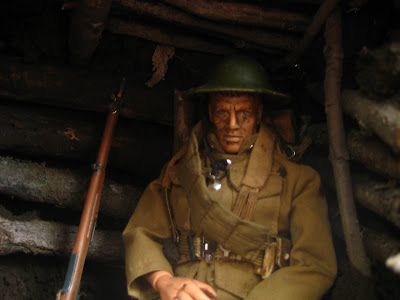
This is how the American soldier, often known by their nick-name "doughboys" looked in the muddy farmland of France. Note how his rifle is fixed with a bayonet, a knife-like weapon that fitted onto the end of gun barrel for close combat.


Here, a soldier fires from his 'rifle pit'. Note that he wears a blanketroll on his back.


When charging the enemy, a soldier tried his best to find the most cover from enemy bullets and mortar shells.

Here a U.S. infantryman comes upon an abandon enemy machine gun nest; they had to take caution when doing this.