 |
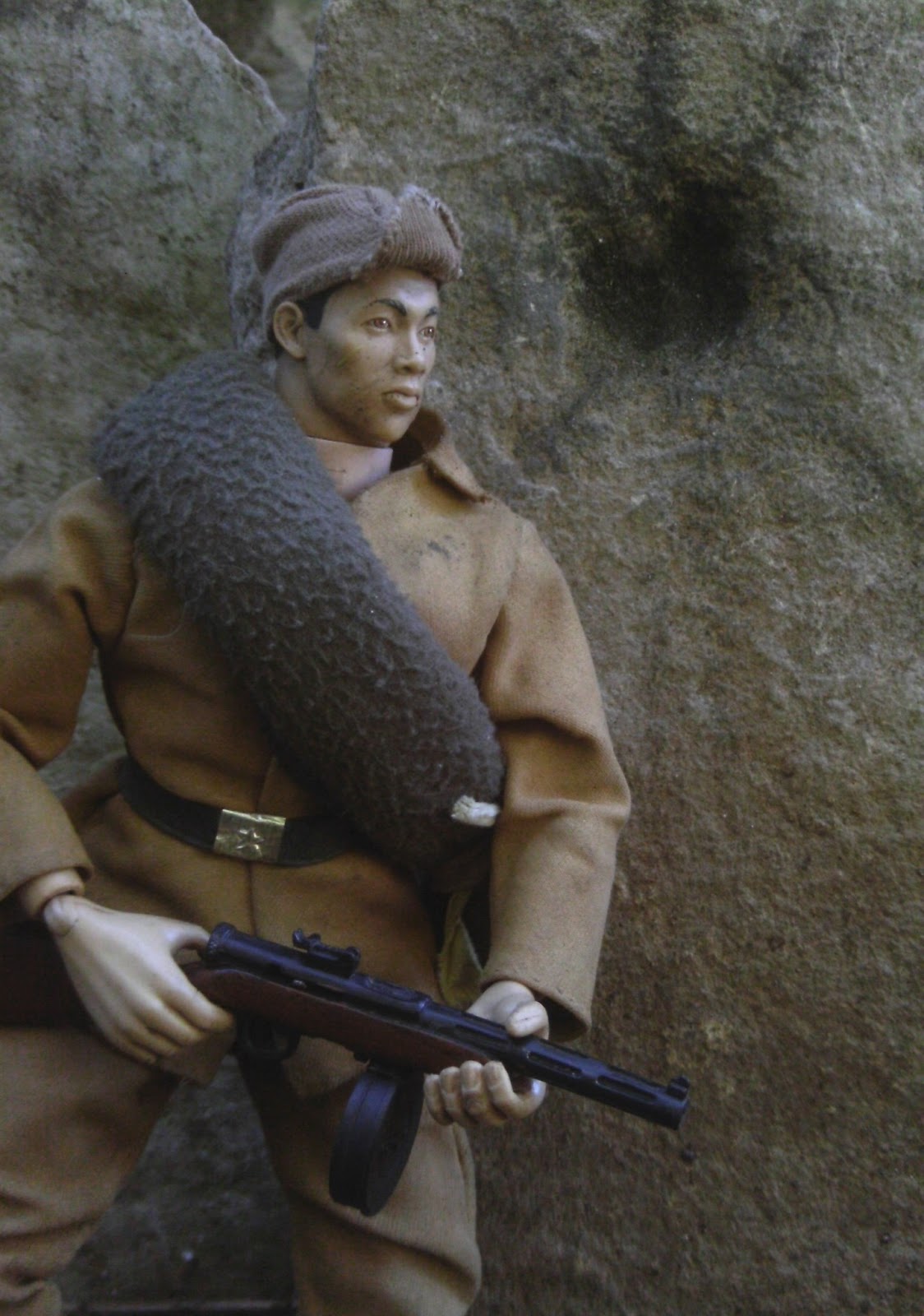
| A North Korean soldier in the Korean War, 1950-1953 |
 The Koreans, however, were dissatisfied with this arrangement. In 1950, five years after the end of World War II, the Soviet-backed North Korean army crossed the 38th Parallel in a campaign to take over South Korea in an attempt to unify the country under Communism.
Three days after the fighting began, the North Korean army took the South Korean capitol city of Seoul. 

 |
| At the start of the war, both of the Korean armies armed themselves with a mix of American, Japanese and Soviet uniforms and gear. |
It wasn't long until the Americans became involved. The United Nations, a newly-formed body of Nations from around the world assembled in the aftermath of the Second World War to assist in international policy decision making, approved American involvement in stemming the tide in South Korea. Though many Nations dedicated against communism would send arms, men and relief aid into the conflict, the United States would take the leading role--and therefore it was decided that Douglas MacArthur, the American General who liberated the Philippines in World War II, would be the Commanding General in charge of all Democratic forces in Korea.
"Communism was acting in Korea just as Hitler, Mussolini and the Japanese had acted. I felt certain that if South Korea was allowed to go unchallenged it would mean a third world war." ~Harry S. Truman, President of the United States during the Korean Conflict
 |
| An American Marine in the fight to hold the Pusan Perimeter in the first year of the Korean Conflict. |
The first United States troops to see action was a rifle company in near Osan, thirty miles South of Seoul. The North Koreans pushed South until the Americans only held the peninsula by a toehold on the Southeastern corner, where the American Army based in Pusan tried to hold onto their last defensive line, the "Pusan Perimeter".
 |
| An American Soldier early in the Korean War |

 |
| The Americans were ill prepared for the harsh Korean winters, and countless cases of frostbite and trenchfoot claimed many limbs. |
 |
| A Chinese soldier in a white quilted winter uniform. |
 |
| An American look-out post on the front lines |

The American and UN forces began a General retreat across the frozen mountainous hills of Korea, the endurance of the Americans in the harsh elements becoming a legend of perseverance. A fierce rear guard action was kept up, with whole divisions of Chinese attackers being almost wiped out by UN aircraft.
 |
| American troops huddled around a camp fire during the retreat South. |
 |
| Unfortunately, small comforts such as camp fires could draw Chinese artillery fire, which was noted for its ferocity. |
 |
| American Artillery pounds away on Chinese positions in Korea. |
The Americans regrouped in Southern Korea and fought off their attackers, but fighting would continue for three more years until an armistice (temporary peace agreement) was agreed upon in 1953.
Sixty years later, the issue of a unified Korea is unresolved.




 Winter was the worst season of all for soldiers in the trenches. The winter also brought many new problems; frostbite and